
Breastfeeding Knowledge
Profound shifts in sensibility in this season of life
I spent most of my thirties breastfeeding my children. Helena was born when I was 33. I just turned 40 and stopped breastfeeding Ulysses — I took no break between them, in fact, I tandem fed them both for about three months after Uly was born. Although it’s been roughly three months since we stopped, I still have a lot of milk. I am in a transitional moment, where I observe many changes happening in my sensibility, yet still feel the presence of the recent past in clear ways. In this text, I aim to share some of the things I've learned during this extensive breastfeeding period, which I believe may be of interest to others and, perhaps, to my children in the future. Although at times I will make general assertions that suggest an understanding of “human biological nature,” I do, in fact, intend to speak only about my own experience and not to prescribe any parameters or demands for other women.
The unnatural and the natural in breastfeeding:
There is a steep learning curve that a woman must navigate quickly to start breastfeeding. Unfortunately, our society’s lack of preparation and understanding of this leaves most women stuck in suffering, and most babies unattended or very prematurely traumatized. The “learning curve" is the unnatural part of it, while, on the other hand, there is still a “natural," a mysterious part of breastfeeding that indeed happens only through the acceptance of the biological necessities and conditions created by our bodies. Here, the experience of “learning” (and consequently the creation of “knowledge”) as a cultural perspective collapses, as what we learn can only truly be achieved by following the instincts and demands of the natural world — aka my body and the baby’s body. Breastfeeding, just like pregnancy, offers the woman a diverse experience of knowledge, which ultimately deeply contradicts the intellectual stance of our previous learning experiences.
When I had Helena, I sought a homebirth with the assistance of a wonderful midwife. I trusted my midwife to guide me through the initial moments of breastfeeding Helena, and she followed the standard approach taught to most health professionals: stimulating the baby's mouth to open and placing the breast in their mouth. A gesture that, when described technically, seems harmless, ignoring the vast and deep sensibility of the birth moment. This technique, employed by doctors and nurses to introduce breastfeeding, is at least half a Century old, and we should have already identified its harmful consequences. With Helena, the shoving of the breast into the baby's mouth led us down the unbelievably traumatic industry of “lip tie" surgery correction. Helena went through the surgery, and I regret it tremendously. Truly, the only “solution" to breastfeeding is to provide time and space for mother and baby (considering their physical and material needs) to bond and figure out their way through the body positions and emotional needs of breastfeeding.
Luckily, with persistence, the breastfeeding journey can be long, and with Helena, I sought to remediate the very first few months of trauma by being with her full-time and giving myself time to learn what I needed to learn. In practice, this meant quitting my full-time fellowship at Binghamton University, postponing the writing of my PhD dissertation, and immersing myself in her new worldly presence, which in our case coincided with the COVID pandemic. As I invested in our relationship, I read so many books about breastfeeding, motherhood, etc., etc., with the disposition of a PhD student, researching a new topic that supposedly wasn’t related to my specific “Latin American art history” field. — yet, the Tropicalia in my mind managed to compose a beautiful song. Here, I want to bring a long quote by the famous psychoanalyst Donald Winnicott, who connected many of the dots necessary to develop a sensibility that sees the first years of life as fundamental to building our humanity (and creative capacities):
“My long experience has made me see that the pattern for relating to objects is laid down in babyhood and that it does matter what happens even at the beginning. It is only too easy to think in terms of reflexes. Doctors and nurses should never fall into the trap of thinking that because reflexes are a fact, they are the whole story.
The baby is a human being, immature and highly dependent, and is an individual having and storing experiences. This has immense practical importance for all concerned in the management of the earliest stages. A really high proportion of mothers could establish breastfeeding if the doctors and nurses on whom they are so dependent could accept the fact that it is only the mother who can properly perform this task. She can be hindered, and she can be helped by being given support in all other respects. She cannot be taught.
There are very subtle things that the mother knows intuitively and without any intellectual appreciation of what is happening, and which she can only arrive at by being left alone and given full responsibility in this limited area. She knows, for instance, that the basis of feeding is not feeding.
It is an insult, or shall I say a kind of rape, when an exasperated nurse pushes the mother’s nipple or the nipple of the bottle into the baby’s mouth and starts up a reflex. No mother left on her own would do this.
A period of time is needed for many babies before they begin to search, and when they find an object they do not necessarily want immediately to make a meal of it. They want to play around with their hands and mouth, and perhaps they want to hang on with their gums. There is a wide range of variation here according to infant and mother.
This is the beginning not just of feeding; it is the beginning of object-relating. The whole relationship of this new individual to the actual world has to be based on the way things start up and the pattern that gradually develops according to the experience that belongs to this human interrelationship of baby and mother.
Here again is a huge subject, one that even concerns philosophers, since the paradox has to be accepted that what the baby creates was already there, and that, in fact, the thing that the baby creates is part of the mother, which was found.
The point is that it would not have been found had the mother not been in the special state that mothers are in when they can present themselves in such a way that they are found more or less at the right moment and in the right place. This is called adaptation to need, which enables the baby to discover the world creatively.”
(Donald Winnicott, Winnicott On The Child, pp.52-53, Cambridge: Perseus Publishing, 2002).
This excerpt by Winnicott mirrored many of my experiences and confirmed the choices and thoughts I had while navigating my experience breastfeeding Helena. Winnicott is famous for his concept of “the good enough mother,” which reminds society that the mother is a human being, and that a human relationship is what is desirable for the proper development of a human baby — in contrast with the modernist desires of automation, total deliverance, highly machinic and mechanic productivist desires that he observed in the 20th Century and that nowadays became even worst with the seductive technologies of our times. Ultimately, as a mother, I felt that the “good enough mother” is useful in the specific (and limited, given the broadness of the mother/child relationship) field in which Winnicott was working, but insulting for real mothers, as we are not to be in any way compared with robots, and we are always way better than “good enough.”
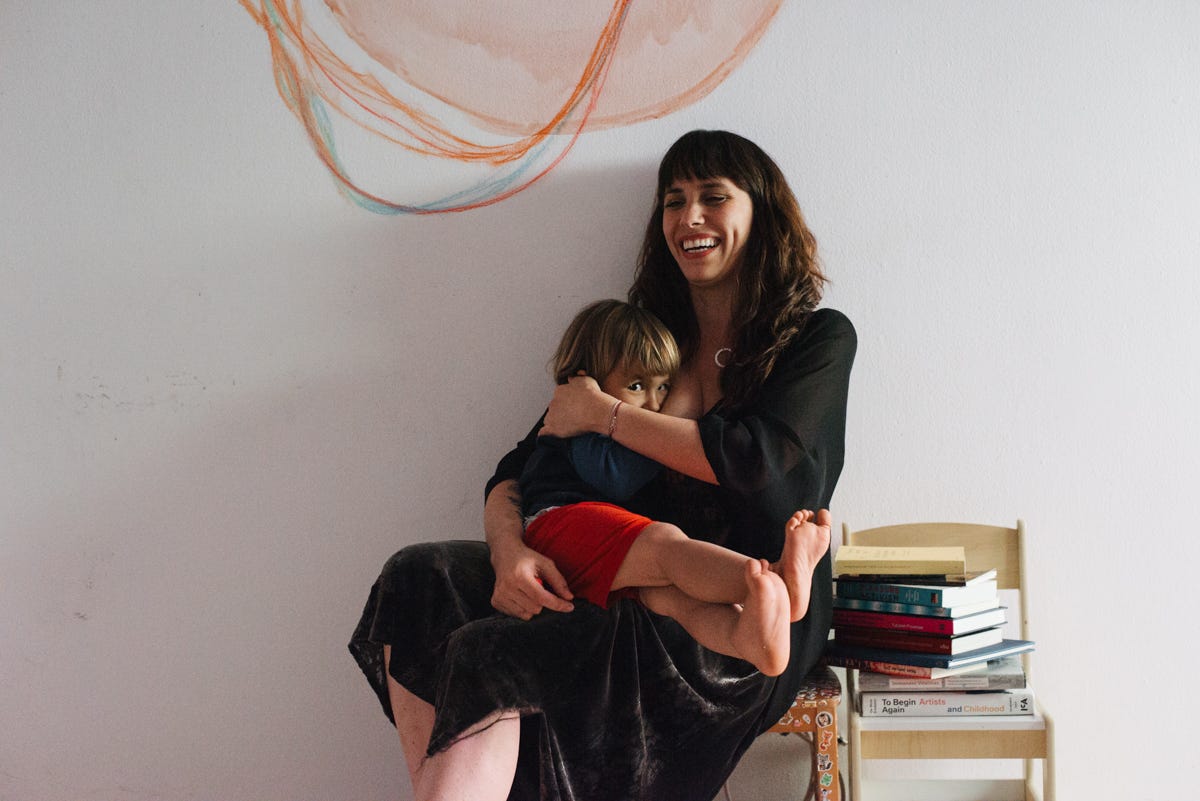
With Ulysses, I had already studied enough about breastfeeding and about the baby’s capacity to latch if left undisturbed. I had watched the very few “breast crawl” videos available on the internet, which prove the newborn’s instinct to find the breast and initiate feeding. I chose to hold Ulysses close to me and not leave him to do the crawl by himself, but I had him next to my breast, and he found the nipple and latched independently, initiating everything in his own volition.
It’s now been three months since I stopped breastfeeding Ulysses, after more than six years of “breastfeeding on demand,” which, to me, truly meant being with my children almost 24 hours per day (including co-sleeping and breastfeeding at night) except for the few hours when their father would take them on walks and to events. When I look back on these six years of motherhood, it is hard to figure out how I have managed life, kept working, and established myself as a full-time artist. There is indeed a complex total-body/total-life transformation that happens with breastfeeding that one cannot fully comprehend, and science is certainly extremely far from accessing. Even as I write this text and know that I am almost completely done producing milk, I feel the effect of the end of breastfeeding in my own thinking, and how fast so many of the memories of it fade away.
Here, I’m trying to remember:
- While breastfeeding, I experienced a quality of thought unlike anything else, as if worlds were opening in my mind or as if constellations and connections were forming. The connection available through Helena’s and Ulysses’s eyes as they stared into mine was more than a view of themselves and me; it created new visions and new people in the world, and brought back many memories inscribed in my body (and buried away in my mind). This was perhaps one of the most challenging parts of breastfeeding: the many memories of what had happened with my body (so, with me) that were activated, and often came excruciatingly alive in my mind; the violence that I experienced in the past starkly contrasted with the necessity of keeping the safety of the baby in my arms.
- The sensibility that is deeply activated with this kind of breastfeeding is one of the rough materiality of life. The contrast between the quality of the touch on the body and the higher senses of our spiritual (or highly mental cognition, if one prefers) is at once highlighted and united. In other words, one becomes intensely aware of the consequential quality of being alive: everything has consequences. Another way to look at this is how this sensibility brings to the immediate reality anything that could be classified as “unconscious,” which might explain why Winnicott became such a good psychoanalyst by working closely with mothers and children, able to explain the reality of object relations.
- Breastfeeding also demanded a constant softness and a willingness to continuously let go of the previous systems that sustained my life, which I kept finding were in harsh contrast to that softness. At times, the contrast felt maddening, but I continued to choose breastfeeding and the softness, to a point that I have been realizing more recently, might not be socially accepted, given the current capitalist/productivist society we live in. Looking back, I also recognize my partner’s influence on this; his unwillingness to experience any of the evident suffering that any refusal of breastfeeding caused in our babies. He was sensitive to the babies’ need for breastfeeding and recognized their desire for it while he was caring for them. As the babies grew, he was attuned to the time he could manage to stay with them, away from me, from 45 minutes to two hours, then three hours or so.
- Now that I stopped breastfeeding, I am noticing an increased capacity for organization and clarity of intentional thought. I suspect that the need for softness that breastfeeding creates changes the configuration of our cognitive system. With both Helena and Ulysses, after I stopped breastfeeding each one of them, I experienced my first clear feeling of anger towards the child. When I first experienced this feeling with Helena, I misunderstood it, thinking I had such a feeling because I was caring for Ulysses, who was a baby. I thought that seeing Helena as a “big kid” compared to a three-month-old baby made me feel angry towards her. It was only when I stopped breastfeeding Ulysses and experienced for the second time the distinctiveness of the sharp-first-time-anger-towards-my-own-child that I could clearly link this feeling with the corporeal shift of stopping breastfeeding. Another clear difference I notice in the quality of my thoughts, within this soft/sharp quality, is an increased capacity to sort and organize material reality, something I have been trying to do over the years of becoming a mother, and that I felt was impossible. Now that I “woke up from the haze of breastfeeding,” I suddenly feel at ease again (and have desire) to deeply organize the bathroom cabinet, look at calendars and make plans, create budgets, etc.