
I am collecting evidence.
As an artist who understands a little bit of science.
My introduction to scientific thinking came through Peirce's broad philosophical method of semiotics, so my thinking links the phenomenological and the symbolic via index and icon. I often go back to it to remind myself that the foundational cognitive step for scientifically understanding the world is the abductive process, that is, the very first recognition in language of a sensorial experience.
This means that what we create for our senses can transform our physicality. Here, I’m thinking more recently of the scientific research about trauma and fibromialgia, for example, and, at the same time, about Lygia Clark’s works and the direct healing potential of what she was creating, which can be lost in common art historical methods that will classify her work as performance or sculpture, or get lost in the fascinating images the work creates. I am also thinking about the power of prayer in Brazilian popular culture and Afro-Brazilian religions, which carry the millenary knowledge of Ifá and Bantu spiritual practices, and about what I learn from Iyengar Yoga and Buddhist meditation. Finally, as the daughter of two physical educators from Brazil, I absorbed, as a child and young person, many references, aesthetic and “health” demands, and practical knowledge about the physical body.
I create, then, playful, easy rituals that I can do while I’m with my family. Through specific, meaningful objects that can carry the moment I’m living, I plan for centering actions that allow me to heal specific body pains, strengthen subtle muscles, and process difficult emotional moments.
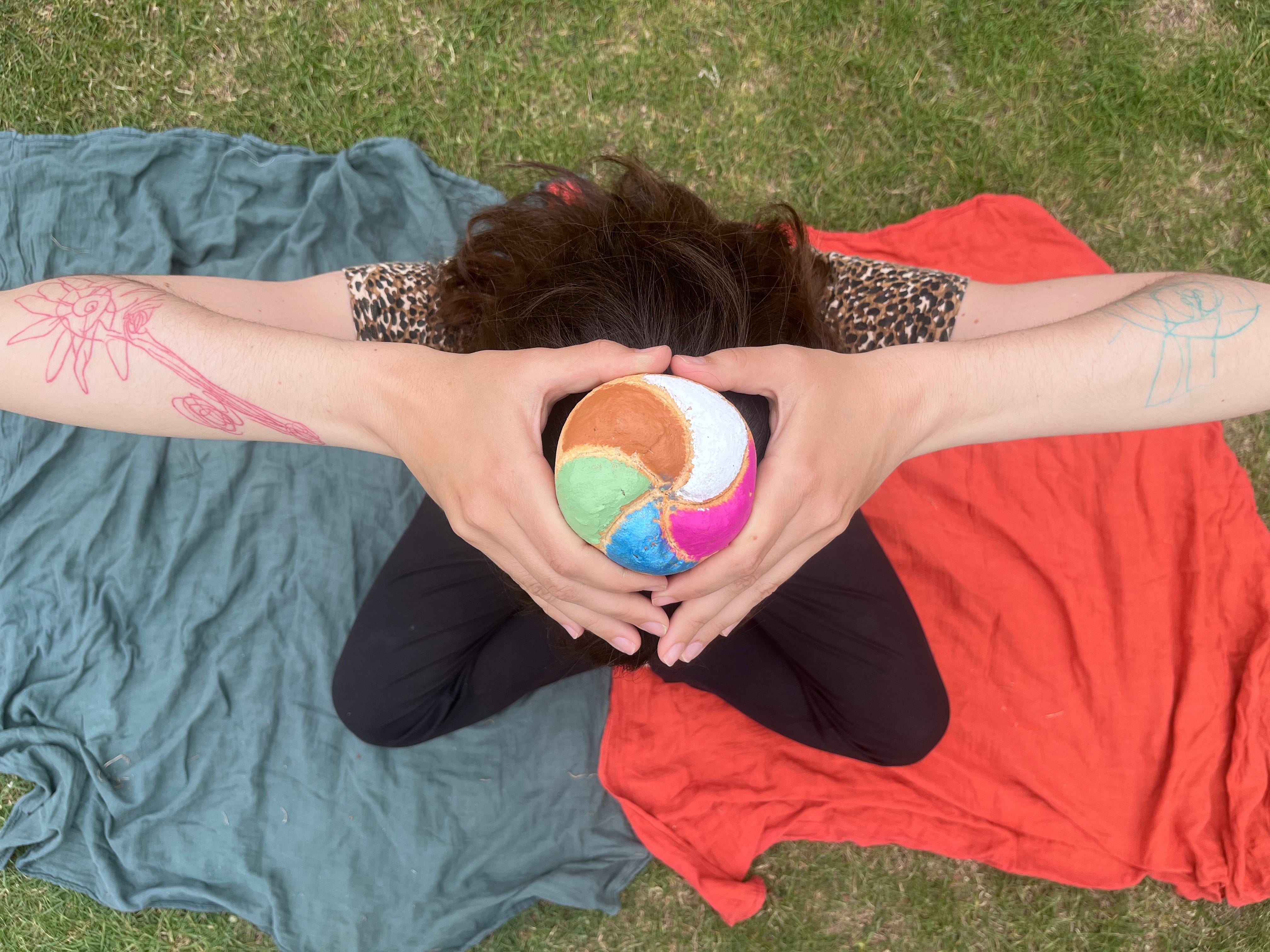
I created the Cosmic Bread while in Warsaw in May 2026, as a way to incorporate the many meaningful moments I lived with my family in Poland after spending five weeks visiting loved ones there. The work also helped me relieve a pulsating headache and muscle pain that were starting to develop in my back. I used that specific bread as the basis for the work, as it is the bulka, the characteristic Polish bread bun. I first noticed the bulka and its importance via another artist’s work: Rafał Zajko, whose work I saw at the Galeria Arsenal in Białystok. Seeing it in Zajko’s work in Białystok was particularly significant for many reasons; first because Helena was the one who showed it to me, second because it was included in a sculpture that speaks to the origin of life, situated within an installation titled Mother, and finally, because the specific round swirly shape of the bulka relates directly with many of the introductory forms I’ve been using in my painting vocabulary. When in Warsaw, Helena found the bulka in a supermarket, and we started buying it daily. Ulysses loved it.


The bulka, like other breads of this kind, hardens perfectly after a few days, so I saved one for my artwork. I then used the few crayons we had left from the trip to add color to it. And I brought the bulka to our last outing in Warsaw. As I have already learned from other works like this, sustaining the inconvenience of carrying the painted bread while doing the regular family activities, explaining my wishes surrounding the artwork to my partner and children, and observing/creating/wainting for the right moment to live the artwork and actually do the significant moment of ritual/play is part of building the effectiveness of the artwork. After that, noticing the transformations that arise from living that specific moment, and how they reverberate in my emotional and physical awareness, is also fundamental to continuing to build this effectiveness. Now, exactly one month after it, I can look back and see the many ways in which the making of this work sustained my physical and emotional return to the US.
I have been understanding these works that integrate object creation with meaning/language and body activation as a collapsing of poetry into the body, which expands the body's capacity and goes beyond our current scientific knowledge of medicine and biology. These works help me understand the limits of art and the undoing of therapeutic propositions. These are points I’ll try to address in another text.


