
Pyrocolengos. Again!
What is a Pyrocolengos?
A Pyrocolengos is first a work of conceptual art: it proposes a new word to encompass the ignitable potential of human relationships. The word can be broken into:
Pyro: Fire
(Ancient Greek word pûr (πῦρ), which means “fire”)*
Co: Togetherness
(traces back to the Latin word com-, meaning “together” or “with”)*
Lengos: Languages/Tongues
(Swahili: In East Africa, it directly translates to “aim,” “purpose,” or “goal”. It is rooted in the Bantu language family and is often used to signify aspiration, destiny, or direction. Slavic Surnames: It is used as a root in Eastern European names (such as Lengowicz), where it relates to words meaning to “bend” or “curve”. In some English linguistic contexts, it traces back to words like the Portuguese língua (language tongue).*
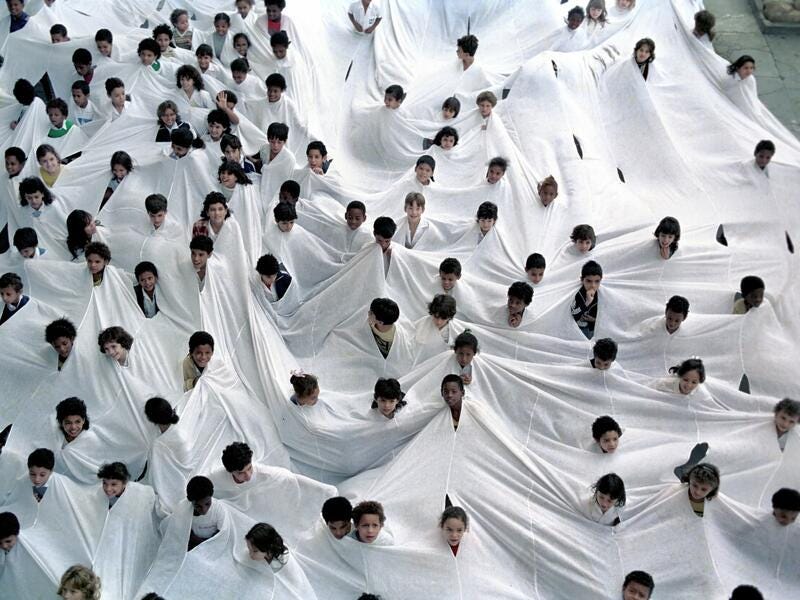
A Pyrocolengos is also a painting created to challenge some of the main premises of contemporary painting as a medium: 1. It is created collectively without the expectation of the unique artistic genius (”The Painter”); 2. It is done to be seen from a horizontal rather than a vertical plane. In other words, one sees the painting while inside it, as an expansive, malleable horizontal field that spreads around their body, rather than an object firmly stretched vertically on the wall; 3. It serves purposes beyond the representational and the imaginary, introducing actionable words and phrases.
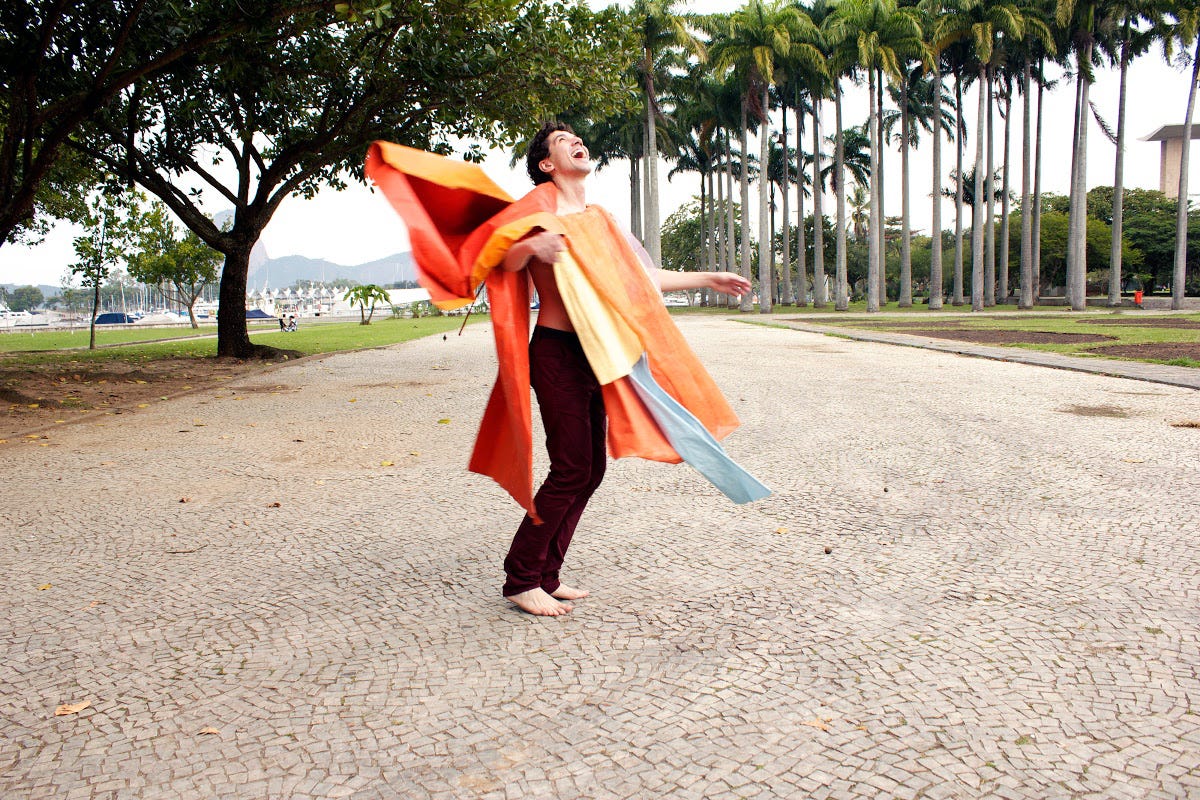
Finally, a Pyrocolengos is a work of corporeality, that is, an artwork that seeks liberation by highlighting our bodies’ aliveness in the present moment. This aspect of the work references, builds upon, and experiments with the work of Brazilian artists and thinkers of the past. Most notably, the Pyrocolengos references in its format Lygia Pape’s work Divisor (Divider, 1968), which was described as a living sculpture [1]; it builds upon Hélio Oiticica’s Parangolés (1964-79) with the playfulness of word-creation to describe a sensation and the individual experience of “in-corporating” the work of art [2]; and it experiments with Paulo Freire’s proposition of praxis, which stated that action towards liberation must involve critical thinking so it doesn’t become pure activism.[3]
Pyrocolengos at The Soil Factory:
Pyrocolengos was first created during my artist-in-residence at The Soil Factory in 2024. At the time, two main Pyrocolengos were created: one that carried the word “Land” for two people, and one that carried the word “End War” for four people. For the Ithaca Parade, Pyrocolengos will use its largest format to date, with space for 12-14 people, and words and phrases collected from The Soil Factory members. Some of the paintings on it were started during my 2023 residency and continued throughout the programs I offered over the years. Other paintings were done specifically for the Ithaca Parade, on a quilt by Jackie Riccio and on reused canvases from my studio.
As we worked together to create this Pyrocolengos, it acquired a few new names: a “soil quilt,” a “collective costume,” a “suspended soil,” all of which add to the work's conceptual capacity. Concerns about people’s ability to move into togetherness, the safety of everyone involved, and others’ willingness to sustain the work throughout the parade also came up. In response to these concerns, I have said that they are all part of cultivating the sensibility to appreciate (and risk!) the diverse experiences of collectively making an artwork.


*The content in between parentheses is copied from Google AI’s answer to the question: “origin word?”)
[1] https://www.metmuseum.org/press-releases/lygia-pape-2016-exhibitions
[2] https://www.forumpermanente.org/administ/revista_ho/revistaHO_eng/ho_asbury-eng2
[3] The specific passage I’m experimenting with is: “The insistence that the oppressed engage in reflection on their concrete situation is not a call to armchair revolution. On the contrary, reflection—true reflection—leads to action. On the other hand, when the situation calls for action, that action will constitute an authentic praxis only if its consequences become the object of critical reflection. In this sense, the praxis is the new raison d’etre of the oppressed; and the revolution, which inaugurates the historical moment of this raison d’etre, is not viable apart from their concomitant conscious involvement. Otherwise, action is pure activism. To achieve this praxis, however, it is necessary to trust in the oppressed and in their ability to reason. Whoever lacks this trust will fail to initiate (or will abandon) dialogue, reflection, and communication, and will fall into using slogans, communiques, monologues, and instructions. Superficial conversions to the cause of liberation carry this danger. Political action on the side of the oppressed must be pedagogical action in the authentic sense of the word, and, therefore, action with the oppressed. Those who work for liberation must not take advantage of the emotional dependence of the oppressed— dependence that is the fruit of the concrete situation of domination which surrounds them and which engendered their unauthentic view of the world. Using their dependence to create still greater dependence is an oppressor tactic.” (Paulo Freire, 1970-2005, p. 66)